
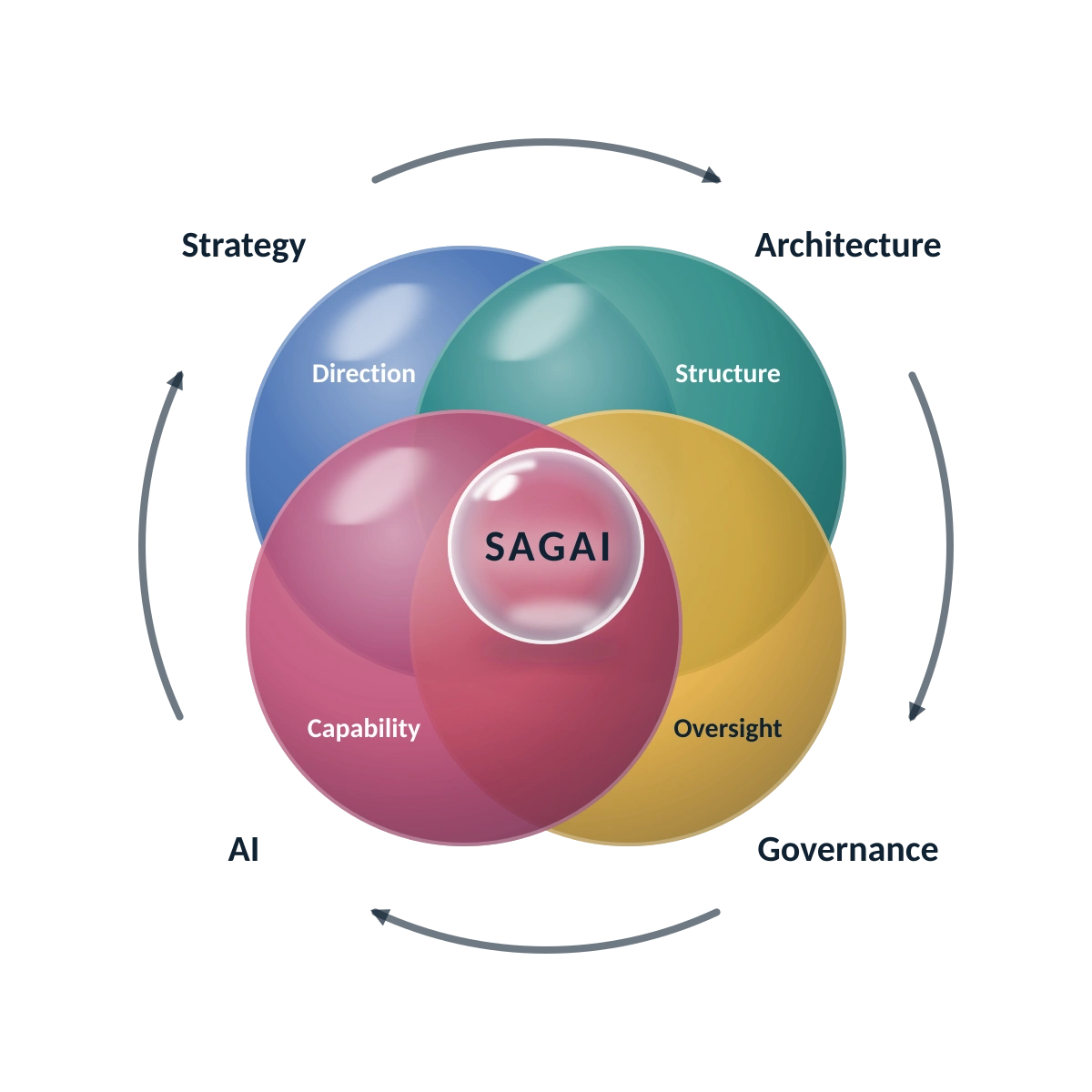
Strategy, Architecture, Governance and AI, working together.
Sagai is a set of frameworks for organisations to work with AI agents, and build their own Strategy, Architecture, Governance and AI.
The name comes from the Hindi word sagāī (सगाई), an engagement ceremony where two families formally commit to each other.
It stands for the idea behind our frameworks: four disciplines that commit to each other from the start, with people and AI working together.
What Sagai covers
Strategy sets the direction, Architecture gives it structure, Governance keeps it accountable and AI puts it to work.

Direction
Where the organisation is going, and what it will and will not do to get there, set out as choices a team can act on.
Structure
How systems, data and teams fit together, so that the strategy can be built without rework.
Oversight
Who decides, and how anyone can check, including how systems connect and who may use which data. Oversight set up early, so that growth does not outrun control.

Capability
Putting AI to work where it earns its place, and saying so plainly where it does not. Sagai ADLC covers building and governing AI agents.
What is Sagai?
Sagai is a set of frameworks for organisations to work with AI agents and to develop their own strategy, architecture, governance and AI using AI agents. The name comes from the Hindi word sagāī (सगाई), an engagement ceremony, where two families get together and formally commit to each other. It stands for the idea behind our frameworks: four disciplines that commit to each other from the start.
Why does Sagai exist?
Advice tends to arrive one discipline at a time. A strategy is written, an architecture follows, governance is added late and AI is bolted on at the end, and each step then has to repair the one before it. Sagai keeps all four in view from the start, so they stay consistent as the work moves.
What does Sagai cover?
Four disciplines, each with a core idea and a framework of its own: Strategy (direction), Architecture (structure), Governance (oversight) and AI (capability).
Which frameworks are there?
Four, one for each discipline:
- Sagai Strategy, for your organisation's own strategy.
- Sagai Architecture, for your organisation's own enterprise architecture.
- Sagai Governance, for your organisation's own governance.
- Sagai ADLC (Agent Development Lifecycle), for AI agents.
The overviews of all four frameworks are published on this website. You can request a copy of the entire framework by submitting the form below and accepting the terms.
What do the frameworks do?
Each framework provides a discipline for an AI agent to work with a human in the loop. You go through the stages, from looking at what you already have to keeping the result up to date, with AI agents drafting and people making the decisions that carry accountability.
- Sagai Strategy covers how you set direction, choose between options, set objectives and measures, split money and people, and keep your assumptions under review.
- Sagai Architecture covers the principles, standards, decision rights, decision records, register of what you run, roadmap and review practice that decide how your business, applications, data, technology and security fit together.
- Sagai Governance covers your charter, decision rights, policies, risk appetite, assurance and exceptions, whatever technology is involved.
- Sagai ADLC is different. It takes an AI agent through its life: scoping it, rating its risk, building it, approving it, running it and retiring it.
None of them supplies your own content. They give you a method, templates and a way to test the result, and the choices stay with you.
Where do people fit alongside AI?
Sagai is about people and AI working together with clear roles. In every Sagai framework the rule is the same: AI agents prepare, people decide. Agents work inside written limits that people set, and an agent can never loosen its own limits. People stay accountable for the decisions that matter. At set points, called gates, a named person records a decision before the work goes on, and an agent can prepare the evidence for a gate but can never pass it. A person can switch an agent off at any time.
How the limits are set differs a little. In Strategy, Architecture and Governance, each agent is given one of three limits for a task: advise (answer questions and lay out options), draft (prepare drafts, marked as drafts until a person accepts them) or check (run checks and report what it finds). No limit lets an agent decide, approve, publish or send. In Sagai ADLC, each action an agent can take is rated for risk, and the agent works at one of five autonomy levels (0 to 4) that those ratings can only tighten.
When should I use a Sagai framework?
Use the one for the discipline you are making decisions in, at the point you are making them. If you are building, approving, running or retiring an AI agent, that is Sagai ADLC. If you are building or reworking your own strategy, architecture or governance, it is the matching one of the other three. Sagai covers four disciplines because the decisions in one affect the others, so the aim is to bring them in together rather than one after another.
Do I need all four?
No. Each framework is complete on its own, and none needs another. Where you use two together they meet at set points. Strategy hands its direction to Architecture as drivers and constraints you state. Governance decides who is accountable for what the others produce. Each of the other three tells you to adopt a framework built for AI agents, such as Sagai ADLC, where your work covers AI agents themselves, and not to rebuild one.
Do Strategy, Architecture and Governance use the same lifecycle?
Yes. They share one lifecycle of seven stages: Assess (look at what you have), Choose (adopt a recognised approach, adapt what you have or create something new, and say why), Design, Build (agents draft, people edit and accept), Test, Put into use and Improve. A gate closes each of the first six stages. Governance also has a gate at Improve. Sagai ADLC has its own lifecycle, for an AI agent, with 13 phases and its own decision gates.
What controls apply to the AI agents I use to build a framework?
Seven, fixed by people before any agent drafts anything. They are the minimum, and a small organisation can meet them with a written page and a habit of keeping to it.
1. Each agent has a named human owner, recorded by role.
2. Each agent has a written list of what it is asked to do, and nothing beyond it.
3. Agents read by default. They do not publish, approve or send anything, or change a document that is in use.
4. What an agent produces is marked as a draft or a proposal until a person accepts it.
5. Prompts and outputs are kept, so a reviewer can see how a text came about.
6. Confidential information goes only to tools the organisation has approved for it.
7. A person can switch an agent off at any time, without needing the agent's cooperation.
Where you want stronger control, the frameworks say to apply one built for AI agents, such as Sagai ADLC.
How is a framework I build tested, and what makes it good?
Four tests, each of which can be run on its own: a tabletop exercise (a realistic scenario walked through with the people who would be involved), a control walk-through (one control followed from the policy that requires it to the evidence that it happened), an evidence check (does the evidence the framework promises exist, is it current and can it be found) and a consistency check (does the framework contradict the obligations that apply or itself). A framework should not go into use until a tabletop exercise and a consistency check have been run.
Five criteria apply to every framework you build: every part has an accountable role, the effort asked of people fits the stakes, decisions are recorded with reasons, the framework is reviewed on a schedule, and the documents name roles and not people. Each of Strategy, Architecture and Governance adds five of its own, which you will find in its own section.
How do I start, and can an AI agent set one up?
Each framework has an implementation guide and a starter instruction file. The guide opens with a section for the person who sets the framework up, then goes one stage at a time, saying who decides at each point and what an AI agent does and does not do. The starter file is text you give to an AI agent so that it loads the framework's files in a set order and helps you set the framework up. The agent drafts and checks, a person decides, and it stops at each gate, never approves anything and never raises its own limits. Both are in each framework's package.
Before you start you need a model that reasons well enough and can take instruction files, a tool approved for the data you will give it, a place to keep the files and a named person who decides. The starter file is only text. It cannot limit the agent's access or check that it followed the rules, so people have to set those up.
Why now?
Agents act rather than only answer, and their outputs are not deterministic, so checking them once is not enough. Organisations are also starting to use agents to draft their own strategy, architecture and governance, which raises the same question of who decides and what the agent may do. Sagai ADLC treats evaluation and monitoring as permanent controls for agents, and the other frameworks keep the accountable decisions with people.
How do I get the detailed framework?
Each framework’s A3 overview is on its page on the website and downloads directly, with no form. The detailed framework comes as a package. To get one, use the request form on the website, say which framework you want, and accept the terms of the Sagai Framework Licence on the form. We then email you a link to the package. Packages are sent by hand, so the email may not arrive straight away. If you have a question about your request, email info@sagai.com.au.
What do I get?
A package for the framework you asked for. It holds the framework documents and templates, an implementation guide with a starter instruction file that you can load into an AI tool, and a worked example for Strategy, Architecture and Governance. It also holds PDF copies of the Executive Briefing, the Detailed Walkthrough, the A3 overview and the implementation guide, the LICENSE, the release notes, and a verification.md for checking the files. The README opens with a “Start here” path that leads to the guide and then to the starter file. The editable decks and the Word copies of the guides are not part of the package. You use the files under Part B of the Sagai Framework Licence, which you accept on the request form and by using them.
Licensing
How is the material licensed?
Each package has one LICENSE file with two parts. Part A is Creative Commons Attribution 4.0 (CC BY 4.0), and it covers the A3 overview PDF and nothing else. Part B is the Sagai Framework Licence, and it covers every other file in the package: the framework documents, templates, profiles, guides, starter files, worked examples and READMEs. You accept Part B when you accept the terms on the request form before you receive a package, and by using the files. A practitioner also accepts it by registering, through the form or by email.
Can I use the material in my own work, including commercially?
Yes, inside your own organisation. Under Part B, in release 2.x, you may use the files, copy them for use inside your organisation, adapt them for its own work and load them into an AI tool as instructions or context. What you make by filling in or adapting them is yours, and you may use it in a commercial business. You may not republish the files, share them with anyone outside your organisation, sell them, build them into a product, service or tool that you offer to others, or use them to train a model. The A3 PDF is different and is covered below.
Can I share the files with another company in my group?
An organisation under Part B includes its related bodies corporate, so companies in the same corporate group count as one. Anyone else needs to take the files from Sagai.
Can I load the files into an AI tool?
Yes. Part B lets you load them into an AI tool as instructions or context, including a third-party AI service, under that service's terms. The starter files are written for this. A tool's own terms may let it keep or train on what you give it, so we advise choosing a service or a setting that does not use your inputs to train its models, and checking the terms of the tool you use. Part B has no clause on this.
Can I use the files to train or fine-tune a model?
No. Part B does not let you use the files to train or fine-tune a model, or to build a dataset for that purpose. Loading them into a tool as instructions or context for a task is allowed.
I am a consultancy. Can I use the material with my clients?
Yes, as a practitioner: a person or firm that helps other organisations use the framework, whether or not for a fee. Register first by submitting the form below or by email to info@sagai.com.au, giving a name, your firm and the framework. If you use the form, enter your firm in Company name. Registering costs nothing, and Sagai uses the details only to keep a list of those who register and to contact them about the licence and new versions. You may then use the files with clients and give a client its own documents, filled in or adapted for that client. Those documents may keep the headings and prompts of the template they were built from. You may not pass on blank templates, guides or worked examples. A client that wants the files takes them from Sagai under Part B. Your own work for clients does not let you republish or sell the files, and credit is needed on published work.
Do I need permission or have to tell you I am using it?
An organisation using the files for itself does not need to ask or register. It accepts Part B when it accepts the terms on the request form before it receives a package, and by using the files, and any organisation may register through the form or by email if it wishes. A practitioner registers before first using the files with a client. For the A3 PDF, Part A needs credit and a link to the licence and nothing else.
How do I credit it?
Credit is needed only on published work, and not for use inside your organisation. If you publish work built on a framework's files, use the line for that framework:
- "Sagai Strategy framework by Aquasila Pty Ltd, used under the Sagai Framework Licence"
- "Sagai Architecture framework by Aquasila Pty Ltd, used under the Sagai Framework Licence"
- "Sagai Governance framework by Aquasila Pty Ltd, used under the Sagai Framework Licence"
- "ADLC (Agent Development Lifecycle) framework by Aquasila Pty Ltd, used under the Sagai Framework Licence"
If you share or adapt the A3 PDF, use the same name with "licensed under CC BY 4.0" in place of "used under the Sagai Framework Licence", link the licence and say if you changed it.
Who holds the copyright?
Each LICENSE reads "Copyright (c) 2026 Aquasila Pty Ltd". The website is also Aquasila Pty Ltd's, and neither part of the licence covers it.
Are the Sagai presentation decks covered by the licence?
Only the A3 overview PDF of each framework, under Part A. The Executive Briefing, the Detailed Walkthrough, the editable decks and the implementation guides are not under Part A.
Can I use the Sagai name, logo or branding?
No. No trade mark rights are granted under either part. An unchanged A3 PDF may keep its branding, and the name may be used to credit the source.
Can I republish a changed version without the branding?
Only the A3 PDF. Under Part A you may adapt it, credit it and say what you changed, and a changed copy must remove the Sagai name and logo. Everything else is under Part B, which does not let you republish the files or copies of them, changed or not.
Liability and Advice
Is this legal, audit or risk advice?
No. The frameworks are general guidance. Nothing in them is legal, audit or risk advice, or advice on your strategy, architecture or governance, so take advice on your own situation before relying on them. Where a part touches law, regulation or safety, the frameworks say an expert or lawyer reviews it before you rely on it.
Who is responsible if I follow it and something goes wrong?
You and your organisation remain accountable for your own decisions, your own agents, and the security and privacy of what you build and run with them. The material is provided as is, with no warranty. To the extent the law allows, Aquasila Pty Ltd is not liable for loss from using it. None of this limits rights that the law does not let anyone exclude, including under the Australian Consumer Law.
Who owns my agents, my data and their security?
You and your organisation do. The AI agents you build or use, the information you give them, the tools and settings around them and the security and privacy of all of it belong to you, and so does the responsibility for them. The documents you produce from the files are yours. Sagai does not run, host or monitor your agents, does not see what you give them and does not check what they produce, and a framework does not enforce anything. A person in your organisation stays accountable for each decision. The frameworks ask you to name that person, to send confidential material only to tools approved for it and to keep the prompts and outputs.
Does following a Sagai framework make me compliant with a law or standard?
No. None of them is a certification, and none issues a certificate. Sagai ADLC includes a legal and regulatory assessment template for recording your own analysis. In Strategy, Architecture and Governance, a part that touches law, regulation or safety goes to an expert or a lawyer for review before you rely on it, and the review is recorded. None of this replaces legal advice.
How do I get in touch?
Email info@sagai.com.au. To request a copy of a framework, submit the form below.
Request the Framework
Please note that by submitting the form below, you accept the licensing terms & conditions.
You also agree that you have read and accepted the licensing terms and liability details as above.
You / your organisation remain accountable for your own decisions, your own agents, the security and privacy of what you build and run with them.
The framework is provided as is, with no warranty. (see licensing & liability details)
We use the details you give here only to send you the pack, to keep a list of the individuals who register, and to contact you about new versions.